Endometriosis

No Results Found 0/0

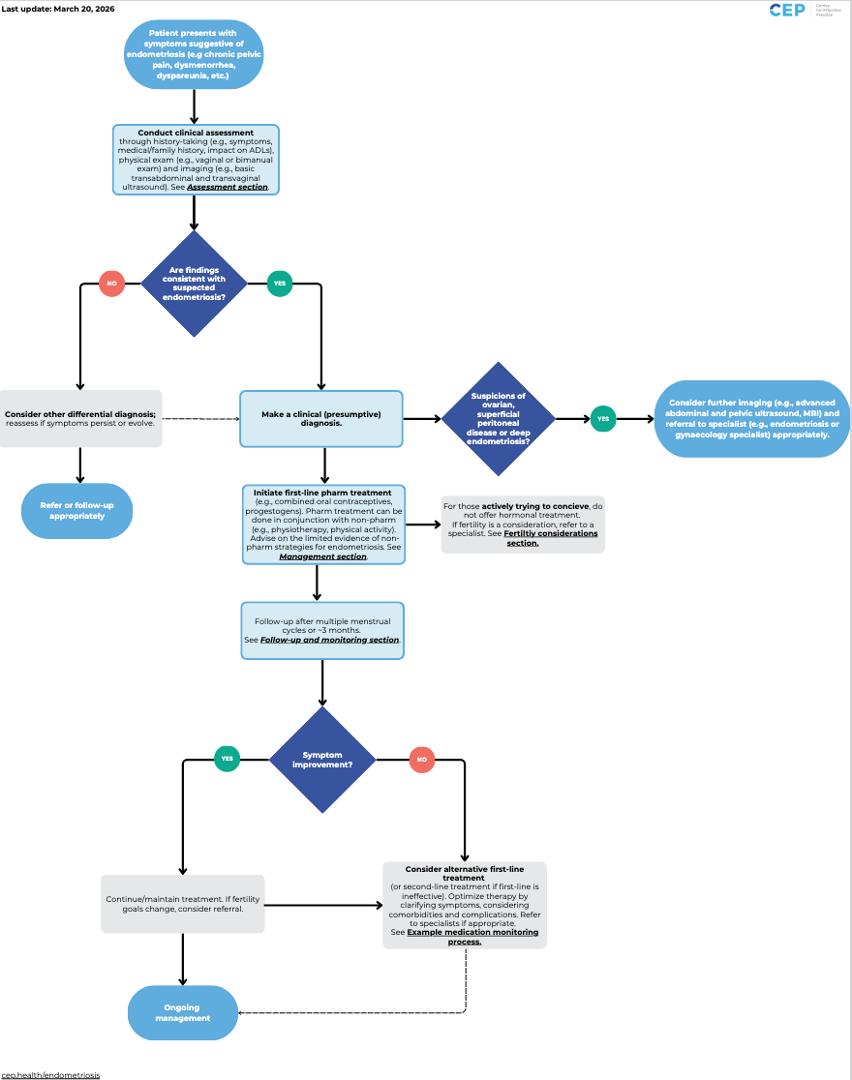
This tool is designed to support primary care clinicians in understanding, assessing and managing endometriosis.

Assessment New

Screening

Consider endometriosis in individuals, including adolescents, presenting with the following symptoms: 

  • Dysuria (pain passing urine)  
  • Dyschezia (painful bowel movements)  
  • Dysmenorrhea (pain associated with menstruation) 
  • Dyspareunia (pain during or after intercourse) 
  • Chronic pelvic pain (> 6 months) 
  • Infertility 
  • Blood in urine  
  • Systems-related symptoms, often with exacerbation related to menstruation:  
    • Urinary tract: hematuria, flank pain  
    • Gastrointestinal: bloating, diarrhea, constipation, obstructive symptoms (nausea/emesis), painful rectal bleeding   
    • Nerve involvement: sciatica   
    • Diaphragm/chest: Shoulder pain or subcostal pain, pneumothorax, hemothorax, cyclical cough/haemoptysis/chest pain 
    • Skin, muscle, fascia: painful mass with catamenial exacerbation at site of previous incisions, umbilicus, perineum/cyclical scar swelling and pain

Risk factors can include: 

  • First-degree relatives with a history or symptoms of endometriosis 
  • Obstructive mullerian malformations 
  • Early menarche (<10 to 12 years) 
  • Short menstrual cycle (<26 to 26-31 days) 
  • Lower body mass index 
  • Nulliparity 
Talking tips to start your assessment
Click for details

Practice points:

  • Routinely validate patient experiences by addressing the psychological and social impacts of endometriosis, including chronic stress, fear of infertility, and the functional consequences of missed work due to pain. Incorporating this approach ensures patients feel heard while facilitating effective management strategies. 
  • Individuals with endometriosis may have a slightly increased risk of ovarian and endometrial cancer, but the absolute risks remain low. No additional cancer screening beyond routine screening guidelines is recommended. 
  • Clinicians should distinguish between symptoms of endometriosis and non-specific secondary symptoms, which often reflect the overall disease burden rather than standalone diagnostic criteria. It is essential to investigate the root cause of pain that disrupts daily function to understand underlying pathology and prevent delay in diagnosis. Even when symptoms overlap with other conditions, recognizing endometriosis ensures that severe pain is not normalized and treatment is initiated. 

Consider endometriosis in individuals, including adolescents, presenting with the following symptoms and risk factors: 

Symptoms

  • Dysuria (pain passing urine)  
  • Dyschezia (painful bowel movements)  
  • Dysmenorrhea (pain associated with menstruation) 
  • Dyspareunia (pain during or after intercourse) 
  • Chronic pelvic pain (> 6 months) 
  • Infertility 
  • Blood in urine  
  • Systems-related symptoms, often with exacerbation related to menstruation:  
    • Urinary tract: hematuria, flank pain  
    • Gastrointestinal: bloating, diarrhea, constipation, obstructive symptoms (nausea/emesis), painful rectal bleeding   
    • Nerve involvement: sciatica   
    • Diaphragm/chest: Shoulder pain or subcostal pain, pneumothorax, hemothorax, cyclical cough/haemoptysis/chest pain 
    • Skin, muscle, fascia: painful mass with catamenial exacerbation at site of previous incisions, umbilicus, perineum/cyclical scar swelling and pain


Risk factors

  • First-degree relatives with a history or symptoms of endometriosis 
  • Obstructive mullerian malformations 
  • Early menarche (<10 to 12 years) 
  • Short menstrual cycle (<26 to 26-31 days) 
  • Lower body mass index 
  • Nulliparity 


Practice points:

  • Routinely validate patient experiences by addressing the psychological and social impacts of endometriosis, including chronic stress, fear of infertility, and the functional consequences of missed work due to pain. Incorporating this approach ensures patients feel heard while facilitating effective management strategies. 
  • Individuals with endometriosis may have a slightly increased risk of ovarian and endometrial cancer, but the absolute risks remain low. No additional cancer screening beyond routine screening guidelines is recommended. 
  • Clinicians should distinguish between symptoms of endometriosis and non-specific secondary symptoms, which often reflect the overall disease burden rather than standalone diagnostic criteria. It is essential to investigate the root cause of pain that disrupts daily function to understand underlying pathology and prevent delay in diagnosis. Even when symptoms overlap with other conditions, recognizing endometriosis ensures that severe pain is not normalized and treatment is initiated. 
Talking tips to start your assessment
Click for details

Diagnosis

Use a patient-centered care approach to diagnosing endometriosis, which involves acknowledging and believing the individual’s reported experiences and symptoms. Care should be trauma-informed and sensitive to the needs of diverse populations. Use empathic communication to help individuals feel safe and supported when discussing their symptoms. Consider factors such as symptom impact, fertility desires, and cultural background. 

Clinical diagnosis
  • Perform a complete history including: 
    • Symptoms  
    • Medical history and previous therapies (e.g. surgical, autoimmune disease, recent ultrasound, pap test or MRI) 
    • Family history  
    • Impact on quality of life and activities of daily living (ADL) 
  • An abdominal and pelvic examination can be used to identify physical signs of endometriosis. Potential benefits of a pelvic examination should be balanced against possible discomfort. See types of abdominal and pelvic examinations section. Goals include: 
    • Distinguishing the type of endometriosis, such as: 
      • Superficial peritoneal disease – endometriotic deposits on the peritoneum 
      • Ovarian endometriosis – cyst formed when endometriosis affects the ovaries 
      • Deep endometriosis – extends beyond the peritoneum with nodular or fibrotic lesions that can involve organs (e.g., bowel, bladder, nerves) or extrapelvic locations such as the skin and diaphragm 
    • Evaluating the degree and localization of pain 
    • Identifying signs of pain syndromes, central sensitization, or dysfunction of adjacent structures 
  • A normal examination does not exclude the possible diagnosis of endometriosis or the need for further investigation.  
Imaging diagnosis

  • Based on history and physical examination, imaging may be required to confirm and clarify diagnosis and show extent of disease.  
    • Basic transabdominal and transvaginal ultrasound may be used for diagnosis.  
    • Advanced abdominal and pelvic ultrasound can be used to diagnose ovarian endometriomas and deep endometriosis. 
    • Pelvic MRI may be used when advanced ultrasound is not possible or unavailable 
  • It is important to note that endometriosis cannot be completely excluded if the ultrasound or MRI is reported as normal, particularly for superficial peritoneal disease. 


Surgical diagnosis

  • Laparoscopy performed by a specialist is considered the ‘gold standard’ for diagnosing endometriosis. However, it is an invasive procedure with associated risks, and challenges in accessing it can further delay diagnosis and treatment. 
  • The risks and benefits of laparoscopy must be weighed with each individual. 
  • A presumptive diagnosis can be made through clinical assessment and imaging, with referrals to specialists for clarification as needed.  
Types of abdominal and pelvic examinations
  • Inspection of vaginal mucosa, looking for posterior vaginal fornix lesionsor any abnormalities 
  • Myofascial examination of superficial, deep, and low abdominal wall, including scars. Evaluate tone, tenderness, allodynia, or hyperalgesia  
  • Bimanual examination looking for tenderness, pain, stiffness, and nodularity  
  • Pelvic organ enlargement   
  • Pelvic and vaginal tenderness   
  • Pelvic masses or other conditions

Gender diverse and racialized individuals experience inequities in accessing appropriate endometriosis care which negatively affects their health outcomes. African, Caribbean, and Black individuals are less likely to receive an endometriosis diagnosis and may face more unnecessary surgical procedures or post-operative complications compared to White individuals. In Canada, a history of reported reproductive coercion contributes to a significant trust barrier for First Nations, Métis, and Inuit individuals. All individuals who experience endometriosis deserve patient-centered, evidence-based quality care.  

Practice points:

  • Gynecologic and pelvic exams can be triggering for individuals who have experienced past trauma or sexual violence. A pelvic examination may not be appropriate for those who have not been sexually active or with vaginal muscle pain. 
  • Enhance individual comfort and reduce procedure-related anxiety by offering verbal guidance, utilizing warmed or plastic speculums of the smallest appropriate size, and have individuals adopt a “butterfly” position instead of invasive stirrups when appropriate. 

Biomarkers should not be used as they cannot accurately diagnose endometriosis. This includes: 

  • Serum CA125* 
  • Biomarkers (individual or panels) in endometrial tissue, blood, menstrual or uterine fluids 

Ca-125 should NOT be ordered for a pre-menopausal patient with an ovarian cyst as it’s not helpful in clarifying the diagnosis and will often be elevated in endometriosis. 

Talking tips for communicating a diagnosis
Click for details

Referrals 

Consider referral to specialists (e.g., fertility, gynecology, pain management) when: 

  • Diagnosis is unclear 
  • First line treatment is contraindicated, not tolerated or not effective 
  • Symptoms are severe/persistent/recurrent  
  • Individuals have related infertility   
  • Imaging indicates endometrioma or deep endometriosis (bowel, bladder, ureter), or endometriosis outside the pelvic cavity 

As endometriosis is a chronic, long-term condition, clinicians should proactively clarify the duration of a specialist referral to ensure uninterrupted access to expert care. 

Management New

Pharmacological management

Employ a shared decision-making approach when considering pharmacological management options. These decisions should consider the benefits and risks of each option, individual preference, co-morbid conditions, side effects, costs, and desire for fertility.

While many first-line treatments are not specifically indicated for endometriosis, they can help manage the condition and endometriosis-related symptoms.

Shared decision-making approach
Click for details
First-line treatment

Hormonal treatments

  • Combined oral contraceptives, progestogens, oral, injectable, and intrauterine systems. 
  • Do not offer if fertility is a current priority. See fertility consideration section. 

NSAIDs or acetaminophen

  • Short trial 
  • Alone or in combination can be considered for endometriosis-related pain, unless contraindicated 

Simple analgesics 

  • May be offered alone or alongside other treatment options, depending on the needs and preferences of the person with endometriosis and considerations such as fertility.  
  • May only reduce endometriosis-related pain.  

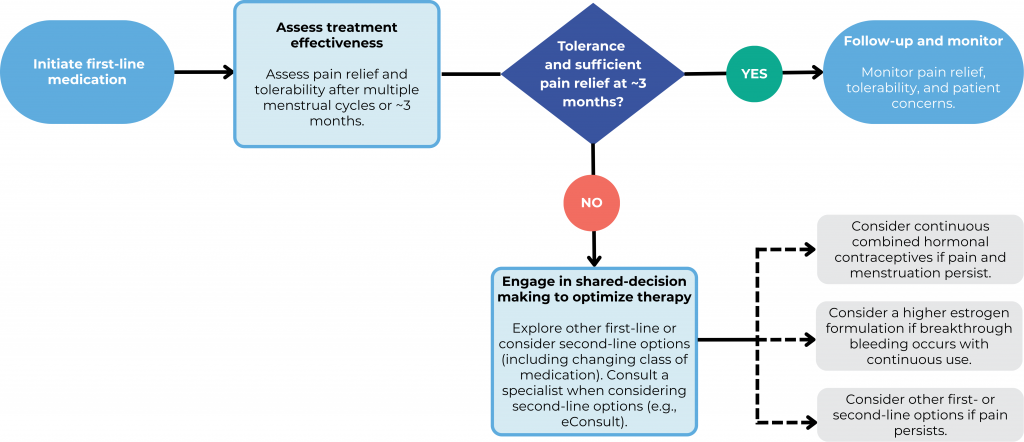
Review firstline treatments for pain relief and tolerability after 3 months. If the previously tried treatments were ineffective or not tolerated, explore alternative options, reviewing after a trial period of another 3 months.

If first-line treatment options have not improved symptoms or are not acceptable to the individual, seek specialist eConsult support to address second-line treatment options or refer to specialist gynecologist services. With support from specialist eConsult, primary care may be able to improve access to these medications for people with endometriosis.  

Second-line treatment

GnRH agonists (plus possible add back hormone replacement therapy) 


  • Considered second-line treatment due to their side effect profile.
  • See medications table for more information.

GnRH antagonists (plus possible add back hormone replacement therapy) 

  • Considered second-line treatment due to their side effect profile.
  • See medications table for more information.

Narcotics

  • If pain is refractory and opioids must be considered, use only for a limited time and at the minimum. 
  • Narcotics should not be prescribed for endometriosis without consulting a pain specialist.

Neuromodulators 

  • When appropriatefacilitate conversations about the benefits and risks of neuromodulators with individuals with endometriosis.
  • Explain that there is limited research to support their use in endometriosis management and that lower doses are used than when treating anxiety or depression.

SERMS and Aromatase inhibitors are not recommended because of limited evidence to support their use. In specific circumstances, such as in cases of pain unresponsive to other treatments, Aromatase inhibitors may be considered alongside other treatments.

Pharmacological management of adolescents
  • Hormonal and simple analgesic options are appropriate for adolescents. Hormonal contraceptives or progestogens are first-line hormone therapy for symptoms in adolescents such as severe dysmenorrhea and/or endometriosis-associated pain.  
  • Be aware that some progestogens may decrease bone mineral density in adolescents.  
  • Consider NSAIDs to relieve endometriosis-related pain, especially if first-line hormone treatment is not appropriate for the individual. 
  • Refer to a specialist for GnRH agonist treatment. It should only be used after careful deliberation and discussion of potential side effects and risks.
Medications table
Talking tips for hormone therapy hestitant individuals
Click for details
Talking tips for discussing cyclic vs continuous use
Click for details
Example medication monitoring process

The prescribing and monitoring process may look different as you consider individual needs and shared decision making.

Non-pharmacological management

Individuals with endometriosis often experience impacts across physical, psychological, sexual, reproductive, and social domains. While high-quality evidence for specific non-pharmacological interventions for endometriosis management remains limited, many individuals seek these approaches to help manage pain, improve function, and cope with symptoms. Pharmacological and non-pharmacological approaches may be used in combination for those seeking both options and it is important to listen to individuals’ preferences when discussing management options.

Clinicians are encouraged to:

Acknowledge the role of non-pharmacological strategies while clarifying that no specific intervention currently has strong evidence for reducing endometriosis-related pain, but they may support general well-being. 

Discuss practical considerations, including variable availability, potential out-of-pocket costs, limited treatment details, and the possibility of adverse effects. 

Promote access to reputable support resources, including local or online support groups, which may provide education*, coping strategies, and community connection. See resources in follow-up section (link). 

*Consider the importance of health literacy and the abundance of misleading information online.  

The following interventions may be considered according to individual preference, symptom severity and clinical judgment:

Non-pharmacological management options

Physiotherapy

  • Examples: Manual therapy such as soft tissue techniques and manipulation; pelvic floor physiotherapy such as Thiele massage. 
  • May improve pelvic pain and pain with intercourse. 

Psychological interventions

  • Examples: Psychotherapy with somatosensory stimulation (acupuncture, moxibustion and heat), mindfulness, counselling.  
  • May make small improvements in pelvic pain and quality of life. 

Acupuncture

  • May make short-term improvements in endometriosis-related pain and quality of life.  
  • Advise that there is limited evidence for the effectiveness of other complementary/alternative approaches in pain management. 

Dietary approaches

  • Examples: FODMAP diet, dietary supplements such as fish oil and vitamin D.
  • Limited evidence, but some may find associations with pain.

Physical activity

  • Examples: Breathing exercises, yoga, muscle relaxation, and walking. 
  • Limited evidence but physical activity may: 
    • Provide pain relief 
    • Improve quality of life 
    • Enhance overall health by reducing stress and improving mood 
    • Help mitigate side effects from pharmacological therapies.  

Practice point: Discuss use of medicinal cannabis and non-prescribed cannabis due to common use. No specific recommendations can be made due to limited evidence for potential benefits and risks of its use.

Fertility considerations

Consider pregnancy intentions when selecting treatment, as endometriosis can affect fertility (with approximately 10-30% of individuals experiencing infertility) and hormonal contraceptives are first-line treatments options. Management differs for individuals with short-term fertility goals (actively trying to conceive) versus long-term fertility goals (future pregnancy desired but not currently trying to conceive). 

Treatment option
Fertility considerations

Hormonal therapy

  • Actively trying to conceive: Do not offer hormonal therapy (e.g., ovarian suppression treatment), alone or combined with surgery, as it does not improve unassisted pregnancy rates.
  • Not actively trying to conceive:  Hormonal treatments are unlikely to be detrimental to future fertility goals.  

Non-pharmacological management

  • Non-pharmacological strategies (e.g., psychological interventions, diet, physical activityetc.) may support general well-being but do not improve fertility outcomes in individuals with endometriosis-associated infertility. 
  • See non-pharmacological management section. 

Surgical treatment

  • Surgical treatments are unlikely to negatively impact future fertility; however, surgery is generally reserved for individuals whose symptoms are refractory to first- and second-line treatments, or for select cases where endometriosis is significantly affecting fertility. In some individuals with severe, medication-refractory pain, surgery may also improve physical, emotional, and psychological well-being, which can indirectly support fertility-related goals. 
  • It is important to note that in individuals trying to conceive, surgical options and associated wait-times or stressors may inadvertently cause delays in pregnancy-related plans. 
  • The decision to pursue surgery should consider the presence or absence of pain symptoms and symptom severity, age, disease type, individual preferences, surgical history, infertility factors and ovarian reserve through shared decision-making. 

Practice point: Management of endometriosis-related infertility should involve a multidisciplinary team, including a fertility specialist. Referral to a fertility specialist is recommended if fertility is a priority.

Surgery treatment and infertility
Click for details

For those with infertility, do not prescribe pentoxifylline, other anti-inflammatory drugs or letrozole outside of ovulation-induction to improve pregnancy rates.

Follow-up & monitoring New

Endometriosis can be a chronic condition with ongoing physical, sexual, psychological, and social impacts. Effective management of endometriosis involves follow-up and ongoing monitoring to ensure treatment plans are optimized and should be tailored to the individual’s symptoms, prior treatments, goals, and disease severity. Care coordination across relevant specialties is essential to address the impacts of endometriosis and optimize outcomes.

Follow-up checklist
Symptoms review
  • Review changes in symptomsside effects, paintreatment management and impact on daily living. 
Pharmacological treatment review
  • Hormonal therapy: Reassess first-line hormonal treatments after 1, 3 and 6 months. If ineffective or not tolerated, consider alternative first-line options  or referral. 
  • Analgesics/neuromodulators: Monitor for effectiveness, side effects, and co-occurring conditions. 
  • Adolescents: Monitor response to hormonal therapy or analgesics, considering bone health and growth. 
  • Fertility considerations: Ensure treatment aligns with pregnancy intentions and adjust monitoring if priorities change. 
Non-pharmacological treatment review
  • Monitor non-pharmacological management plans by assessing the need for pelvic physiotherapy and psychological therapy to ensure they align with an individual’s progress and preferencesSee non-pharmacological management section.
Referral considerations
  • Non-response to first-line therapies 
  • Severe or progressive symptoms 
  • Development of complications (e.g., endometrioma, deep endometriosis involving the bowel, bladder, or ureter, fertility) 
Follow-up schedule
  • Schedule follow-up visits after 3–4 months when initiating or modifying treatment. Transition to annual visits once individuals are stable and routinely assess quality of life and fertility status. 

References